2026-09-18
When entering a metal mesh production facility, you may notice that certain areas are illuminated entirely by yellow light. Why is the room designed this way? Does yellow light alter the metal, or does it directly participate in forming the metal mesh?
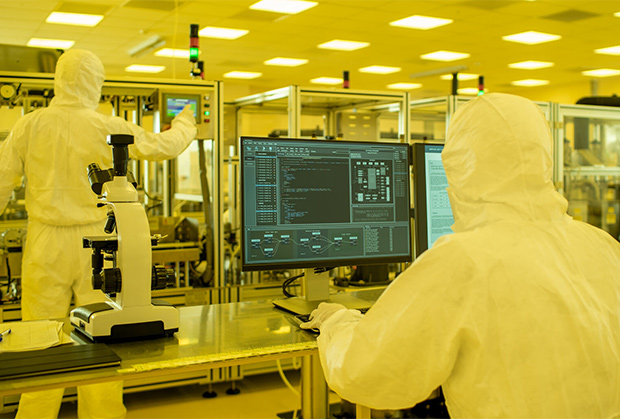
The primary purpose of a yellow-light room is to protect a light-sensitive material used in photolithography: photoresist.
Similar in principle to a photographic darkroom, a yellow-light room uses carefully controlled safe lighting. By filtering out wavelengths that could unintentionally expose the photoresist, it helps maintain the accuracy and consistency of the microscopic patterns used to produce metal mesh.
A yellow-light room is a production area in which the spectrum of the ambient lighting is carefully controlled.
Ordinary white light contains a broad range of wavelengths, including violet and blue light, as well as small amounts of ultraviolet radiation. Depending on the photoresist being used, some of these shorter wavelengths may trigger an unwanted photochemical reaction.
Yellow-light rooms therefore use dedicated lamps and filtering materials to suppress the wavelengths to which the photoresist is sensitive. Once most ultraviolet, violet, and blue light has been removed, the remaining illumination appears yellow or amber.
Light control is not limited to ceiling fixtures. Windows, doors, observation panels, equipment indicators, and other potential sources of white light may also require suitable filters or shielding.
It is also important to note that not every metal mesh manufacturing step must take place under yellow light. This controlled environment is mainly required during photoresist coating, handling, pattern transfer, and other photolithography-related processes.
Metal mesh consists of a large number of continuous and precisely arranged microscopic metal lines. To transfer the designed pattern onto a substrate, the manufacturing process may use a photosensitive material known as photoresist.
After the photoresist is applied, it is exposed to a controlled light source through a photomask or other imaging system. The exposed and unexposed areas react differently during development, creating the pattern required for subsequent processes such as etching.
Because photoresist is light-sensitive, it must be protected from uncontrolled illumination before the intended exposure step.
A simple comparison is undeveloped photographic film. If the film is exposed to unrelated light before the image is properly captured, the final result may be damaged. Photoresist follows a similar principle: it should react only under defined exposure conditions, not under ordinary room lighting or sunlight.
If the photoresist is unintentionally exposed, it may cause:
For large-area metal mesh, even a small local defect may be repeated across a large number of microscopic patterns. Controlling ambient light is therefore an important part of maintaining pattern consistency.
Many photoresists used in photolithography are especially sensitive to ultraviolet light and certain violet or blue wavelengths. A properly designed yellow-light environment filters out these shorter wavelengths while retaining enough longer-wavelength visible light for operators to work safely and efficiently.
Depending on the photoresist system, the lighting may be designed to block wavelengths below a specified cut-off point—often around 500 nm. The exact requirement, however, must be determined according to the sensitivity range of the photoresist being used.
Yellow light is selected primarily because it provides a practical balance between photoresist protection and workplace visibility.
Preventing Unintended Exposure
The most important function of yellow safe lighting is to suppress the wavelengths that could prematurely expose the photoresist.
This allows the material to remain stable during coating, transportation, alignment, inspection, and other operations before controlled exposure takes place.
Maintaining Adequate Visibility
Working in complete darkness would make material handling, equipment operation, alignment, and surface inspection extremely difficult.
Yellow illumination allows operators to see the substrate, equipment, tools, and surrounding workspace while reducing the risk of accidental photoresist exposure.
Supporting Stable Process Control
A controlled lighting environment removes one potential source of process variation. When the photoresist is exposed only at the intended time and under defined conditions, the resulting pattern is more likely to remain clear and consistent across the substrate.
Improving the Working Environment
Compared with very dim red lighting, yellow illumination can offer better visual recognition of equipment, surface conditions, and operational details. This makes it a practical choice for production areas where staff must work for extended periods.
Not necessarily.
A yellow-light room is not defined simply by the visible color of the lamps, nor does it require a perfectly monochromatic light source. What matters is the actual spectral output of the lighting system and whether it sufficiently suppresses the wavelengths that can affect the selected photoresist.
Two rooms may appear equally yellow to the human eye but provide very different levels of photoresist protection.
For this reason, yellow-light environments should be evaluated according to:
Red or green safe lighting may also be suitable for certain photosensitive materials. However, the appropriate lighting color cannot be selected solely on the basis of visible appearance. It must match the spectral sensitivity of the actual photoresist while providing sufficient visibility for production operations.
Yellow light does not modify the metal or directly create the metal mesh pattern. Its role is to provide a controlled environment for the photoresist used during photolithography.
By filtering out potentially harmful ultraviolet, violet, and blue wavelengths, the yellow-light room helps prevent unintended exposure before the designed pattern is transferred. This supports clearer pattern edges, more consistent microscopic lines, and greater production stability across large-area metal mesh products.
A yellow-light room is therefore more than a distinctive type of factory lighting. It is an essential part of photolithography process control.



 English
 العربية
 Čeština
 Dansk
Dansk Nederlands
 Français
 Deutsch
 Ελληνικά
 Magyar
 Italiano
 日本語
日本語 한국어
한국어 Polski
 Português
 Español
 Türkçe
 Українська
 Tiếng Việt

