2026-03-12
Smart Glass, also called Switchable Glass or Electric Glass, is defined as glass or glazing whose light-transmission properties are altered when light, heat, or voltage is applied. Smart Glass changes to different levels of opacity or transparency on demand as it either lets light pass through or blocks some or all of its wavelengths.
The two most common types of technologies used to create active Smart Glass are SPD and PDLC. So what’s the difference between them?
SPD stands for “Suspended Particle Device,” which are rod-like particles that are suspended in a matrix. This matrix is coated between two sheets or PET (which stands for polyethylene terephthalate, a form of polyester) that are coated with ITO (Indium Tin Oxide)(ITO). This film is then laminated between two pieces of glass creating SPD Smart Glass. It is also known as self-tinting dynamically variable glass, automatic solar control glass and obscure glass. SPD blocks up to 99% of visible light, making it primarily used for shading and energy control, without blocking views.
PDLC (Polymer Dispersed Liquid Crystal), on the other hand, contains liquid crystals that are dispersed into a polymer glue-like material. It is also coated between two pieces of PET-ITO to create a film, which is either laminated into glass, or applied as a sticker to existing glass, or other transparent materials. Because it has a light transmittance of 80%, it is ideal for creating a light filled privacy solution in its opaque state.
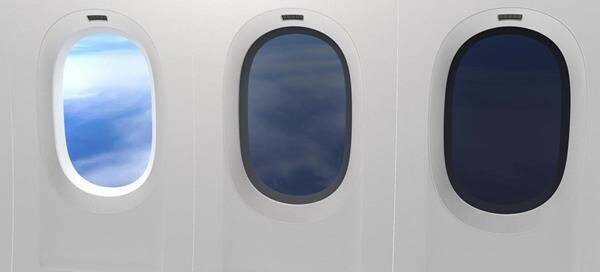
Both SPD and PDLC are controlled by applying electrical voltage. The glass becomes opaque (off/no voltage) when the molecules are randomly aligned, blocking light, and transparent (on/with voltage) when the same molecules are aligned, letting the light through.
The uses of SPD and PDLC differ. Liquid Crystal Glass is typically used by architects and interior designers in interior switchable glass partitions where the ability to change between privacy and transparency is a top priority. As a result, it is often used in offices, bathrooms, and hospitals. On the other hand, SPD technology is ideal for shading because it can block up to 99% of light, with a switching speed of up to 3 seconds, no matter the size of the glass. Because of its tinting and shading capabilities, SPD Smart Glass is ideal for exterior glass such as skylights, facades in buildings and automotive sector.
SPD’s dimmable technology provides the ability to change between the desired level of shade and light blocking and/or full transparency in up to 3 seconds no matter the size of the glass. It is ideal for use in building facades, windows, and skylights. It is available in custom sizes and shapes, can be laminated into curved glass unlike electrochromic smart glass, and can be controlled manually or with automation systems.
There are many benefits to choosing SPD Smart Glass for buildings:
Smart glass using metal mesh transparent conductive film represents a key step forward in SPD technology. Instead of the traditional ITO (Indium Tin Oxide) layer, this glass uses an ultra-fine grid of metals like silver or copper. This metal mesh structure solves the main problem of making a material that is both highly conductive and highly transparent. It has a much lower square resistance than ITO, which means the glass responds faster and uses less energy, especially important for large windows. It is also very flexible, allowing for curved or bendable smart glass designs.
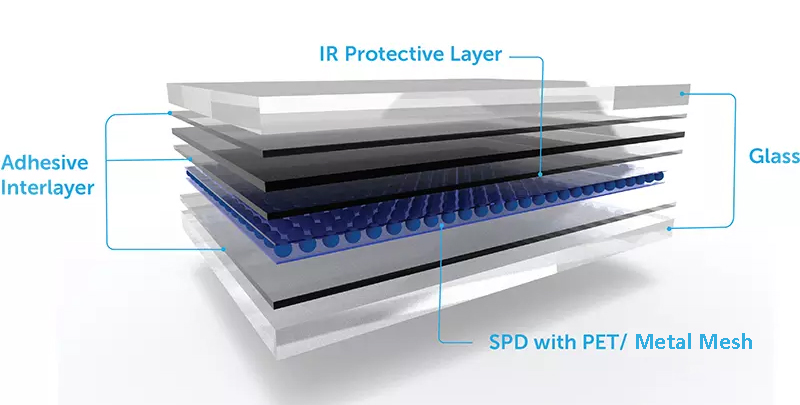
When a voltage is applied, it causes the particles suspended in the film to line up instantly, allowing light to pass through. Thanks to the excellent conductivity of the metal mesh, this dimming happens in seconds and can be adjusted smoothly from clear to dark. This gives users total control over sunlight and glare, making indoor spaces more comfortable. It also blocks over 99% of UV rays and reduces heat from the sun, which lowers the need for air conditioning and saves energy.
MICRON is a high-tech enterprise specializing in the research and development and manufacturing of copper Metal Mesh conductive technology, possessing hundreds of technology patents and a wealth of application cases. If you need to purchase related accessories or find a manufacturing partner for SPD smart glass, please contact us immediately.



 English
 العربية
 Čeština
 Dansk
Dansk Nederlands
 Français
 Deutsch
 Ελληνικά
 Magyar
 Italiano
 日本語
日本語 한국어
한국어 Polski
 Português
 Español
 Türkçe
 Українська
 Tiếng Việt

