2025-12-19
When designing applications that rely on infrared technology—be it a sleek smartphone with facial recognition or a responsive optical touch interface—a critical challenge often arises: the cover glass, meant to protect the display, can significantly attenuate the IR signal.
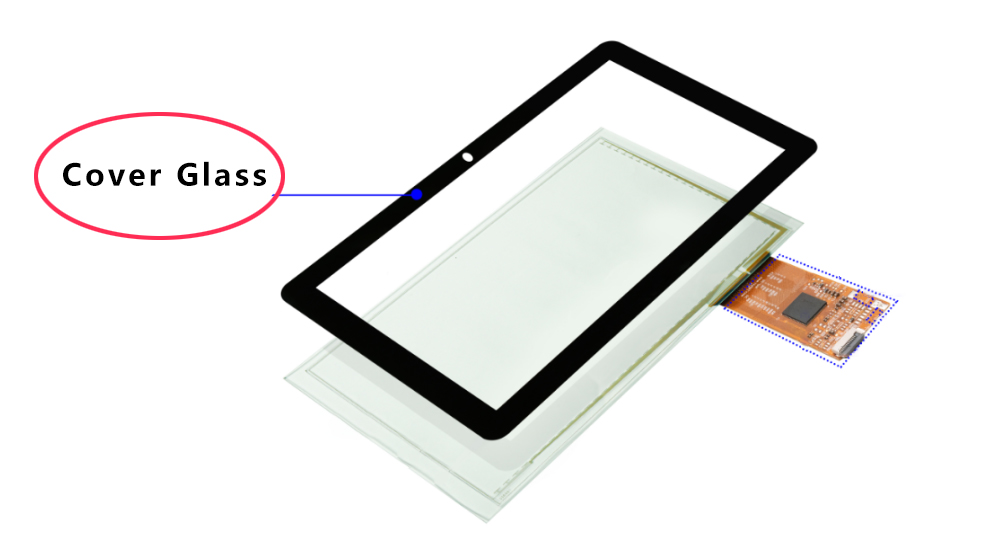
Orient Display FAE team is here to help! This essay offers a clear comparison of glass types and thicknesses to guide you in selecting a solution that maximizes transmittance and ensures end-user reliability.
Light transmittance refers to the percentage of incident light that can pass through the glass cover of a display. It is expressed in percentage (%).
Example: A transmittance of 85% means 85% of the incoming light can pass through the glass.
| Factor | Description & Impact |
| Glass Type | The material composition is fundamental. Soda-lime glass, Ultra-clear glass (low-iron), and Aluminosilicate glass (e.g., Gorilla Glass) have different inherent transmittance. Low-iron glass typically offers higher transmittance. |
| Thickness | Thicker glass leads to greater light absorption and scattering. Thinner glass generally provides higher transmittance. For example, transmittance may increase from ~81% at 2.9 mm to ~87% at 2.0 mm for Soda-lime glass. |
| Surface Coating | Coatings like Anti-Glare (AG), Anti-Reflection (AR), and Anti-Fingerprint (AF) alter how light interacts with the surface. While AG may reduce it, AR coating is specifically designed to increase transmittance by reducing surface reflection. |
| Polarizer Attachment | Adding a polarizer changes the light’s polarization state and typically reduces overall transmittance significantly. Special “high-brightness” polarizers can recover a small amount (~1.3-1.5%). |
| Boarder Silk Screen Printing | Black ink printing on the borders is opaque and blocks all light. This does not affect the material’s intrinsic transmittance but reduces the effective viewable area for light transmission. |
While visible-light transmittance affects display brightness and clarity, the transmittance at infrared wavelengths—especially around 940 nm.
940 nm refers to the wavelength of infrared light, the transmittance of cover glass at 940 nm is critical for ensuring accurate sensor performance, Infrared light (IR) at 940 nm is widely used in proximity sensors, facial recognition, optical touch, and remote-control systems because it is safe, energy-efficient, and undetectable to the human eyes.
Many modern electronic devices integrate sensors that rely on infrared light. These components are often located behind the cover glass of displays or touch panels.
| Application | Usage of 940 nm IR |
| Smartphone face recognition | IR illumination and depth sensing |
| Proximity & gesture sensors | IR reflection and detection |
| IR touch and in-display fingerprint | Optical transmission through cover glass |
| Remote controls / IR communication | 940 nm IR LED |
| TOF (Time-of-Flight) sensors | Distance and depth mapping |
For these functions to work properly, the cover glass must allow sufficient infrared light to pass through. In many specifications, a minimum IR transmittance (such as ≥80% at 940 nm) is required.
Different glass types have different absorption characteristics for near-infrared light.
| Glass Type | Transmittance at 940 nm |
| Standard soda-lime glass | ~75–82% |
| Low-iron ultra-clear glass | ~85–90% |
| Gorilla/ Dragontrail or aluminosilicate glass | ~88–92% |
| Thickness | Typical IR Transmittance at 940 nm |
| 3.0 mm | 74% – 78% |
| 2.9 mm | 79% – 81% |
| 2.5 mm | 80% – 82% |
| 2.0 mm | 83% – 87% |
| 1.1 mm | 85% – 87% |
| 0.7 mm | 86% – 88% |
| Thickness (mm) | Typical IR Transmittance at 940 nm (%) |
| 3.0 mm | 84% – 87% |
| 2.9 mm | 85% – 87.5% |
| 2.5 mm | 87% – 89% |
| 2.0 mm | 89% – 91% |
| 1.1 mm | 91% – 93% |
| 0.7 mm | 92% – 94% |
| Thickness (mm) | Typical IR Transmittance at 940 nm (%) |
| 2.9 mm | 88% – 90% |
| 2.0 mm | 90% – 92% |
| 1.5 mm | 91% – 93% |
| 1.1 mm | 92% – 94% |
| 0.7 mm | 93% – 95% |
Chemically strengthened aluminosilicate glass has the best infrared transmittance, making it ideal for cover glass over sensors, cameras, and biometric modules.
| Glass Type | IR Performance | Strength | Cost | Typical Usage |
| Standard Soda-Lime | Low | Low | ★ | Basic cover glass, low-cost devices |
| Low-Iron Ultra-Clear | Medium | Medium | ★★ | Displays, automotive, touch cover |
| Aluminosilicate | High | High (chem-strengthened) | ★★★ | Premium cover glass, sensor window, face/fingerprint ID |
| Use Case | Recommended Glass |
| Standard display cover | Standard soda-lime or low-iron glass |
| High-brightness display | Low-iron ultra-clear glass |
| Optical/fingerprint touch | Low-iron or aluminosilicate glass |
| Face ID / IR sensing / camera | Aluminosilicate (thin, high IR transmission) |
| Automotive HUD / display | Low-iron or aluminosilicate |
| Coating Type | IR Impact |
| AR (Anti-Reflection) | Improves IR transmittance |
| AG (Anti-Glare) | May scatter and reduce IR |
| AF (Anti-Fingerprint) | Minimal effect |
| IR-blocking film | Blocks infrared transmission |
Selecting the optimal cover glass is a strategic decision that extends beyond durability and cost. For devices featuring facial recognition, proximity sensing, or optical touch, the cover glass serves as the critical optical gatekeeper. The data presented confirms that by prioritizing high-transmittance materials—such as low-iron or aluminosilicate glass—and minimizing thickness, engineers can effectively future-proof their designs. This approach ensures robust sensor performance, unlocks new user experiences, and maintains a competitive edge in an increasingly sensor-driven market.



 English
 العربية
 Čeština
 Dansk
Dansk Nederlands
 Français
 Deutsch
 Ελληνικά
 Magyar
 Italiano
 日本語
日本語 한국어
한국어 Polski
 Português
 Español
 Türkçe
 Українська
 Tiếng Việt

