2025-12-05
OLED stands for Organic Light-Emitting Diode. It is also known as an Organic Electroluminescent (EL) Diode. OLED is a relatively new display technology used in televisions, smartphones, and laptops. Since its invention in 1987, OLED has become one of the two leading display technologies in the industry. This display technology uses organic (carbon-containing) compounds that emit light when an electric current passes through them. Unlike LCDs (Liquid Crystal Displays), which use RGB (Red, Green, Blue) color filters in front of a white light source to produce full color, OLED displays use OLED emitters to generate their own light.
There are many different types of OLED technologies. The most common type is AMOLED, or Active-Matrix OLED, which is the primary type used in OLED TV screens and mobile phones. AMOLED uses thin-film transistors (TFTs) as semiconductors, making the display more efficient. There is also Passive-Matrix OLED (PMOLED), which does not use thin-film transistors. PMOLEDs are easier to manufacture but less energy-efficient than AMOLEDs. Additionally, there are PLEDs (Polymer Light-Emitting Diodes) and Quantum Dot OLEDs (QD-OLEDs). QD-OLEDs use quantum dots, which are nanocrystals that also emit light, alongside traditional OLED materials.
In the context of OLED, “organic” refers to its chemical definition: molecules composed of carbon chains or carbon rings, along with other elements. These organic molecules are electroluminescent, meaning they emit light in response to an electric current.
LED stands for Light-Emitting Diode. This refers to any system with two electrodes that emits light in the presence of an electric current. The electrodes have opposite charges: the positively charged electrode is called the cathode, and the negatively charged electrode is called the anode. Between the electrodes is an organic layer. Thus, when electrons flow from the cathode to the anode, creating an electric current, they pass through the organic material and emit colored light.
An OLED panel consists of six layers. The outermost layers are the sealing layer and the substrate, which are made of plastic or glass. The substrate serves as the foundation of the OLED, while the seal protects it from the environment. Between these two layers are the cathode and anode. At the very center are two layers of organic molecules: the emissive layer and the conductive layer.
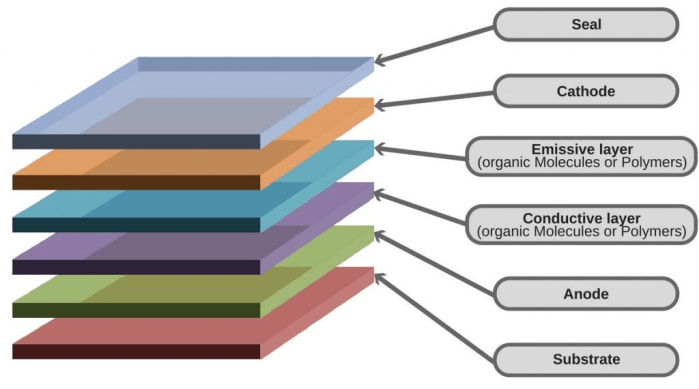
OLEDs work similarly to LEDs but use organic molecules instead of other semiconductors to produce light. An electric current flows from the cathode to the anode through the emissive and conductive layers, generating colored light. The primary OLED materials are yellow and blue, and color filters are used to create the remaining colors.
OLED display technology offers extremely high image quality and wide viewing angles. This is why it is used in high-end products, such as the latest premium Apple phones. Since each pixel in an OLED display can be individually controlled, OLED displays have higher resolution. Additionally, OLEDs do not require a backlight, so they consume less power than LCDs. They are also energy-efficient displays because, instead of constantly powering a backlight, energy is emitted only when pixels are turned on. The absence of a backlight also enables flexible OLED displays. Backlights restrict designers to flat displays, but OLEDs emit their own light, allowing for rollable or foldable devices.
Moreover, OLEDs have faster response times than LCDs, making them ideal for gaming and virtual reality. They can also be very durable, with a lifespan of about six years when used 22 hours a day. OLEDs now offer a larger color gamut (color selection) and higher HDR (high dynamic range) contrast than before.
Since the older Cathode Ray Tube (CRT) became obsolete, LCD and OLED have been the two biggest display technologies. However, OLEDs outperform LCDs in color contrast, viewing angles, flexibility, refresh rates, and power efficiency. Because LCDs rely on a backlight—a light placed behind the device to display images—they can never achieve true black like OLEDs. OLEDs can display deeper, more realistic black levels. Due to the LED backlight, OLEDs also consume less power than LCDs. OLEDs only emit light when an electric current passes through them, so without current, there is absolutely no light. OLEDs can also adjust the brightness of a picture pixel by pixel. In contrast, LCDs can only dim small areas of the screen due to backlight limitations, as the only way to darken the image is to reduce the backlight’s brightness, which is not feasible for each pixel individually. Another advantage of OLEDs is that they emit less blue light compared to LCDs, as they do not require a backlight.
The main advantages of OLED displays are high color contrast, wider viewing angles, and flexibility. The pure black of OLED displays makes other colors stand out more. Compared to LCDs, OLEDs also lose less color contrast at wider viewing angles. LCDs only achieve high color contrast when viewed straight on. OLEDs are also significantly thinner than other displays because they do not require a backlight. The absence of a backlight also allows them to be manufactured on curved surfaces, enabling rollable and foldable devices.
OLEDs use organic materials to emit light, while LEDs use other compound semiconductors. OLEDs can also be made into standalone devices, whereas LEDs can only serve as backlights for LCD displays.
OLED screens are better for the eyes compared to other devices like LCDs because they emit less blue light. The backlights of other displays emit significant amounts of blue light. OLEDs emit much less blue light (65%) compared to LCD displays (34%).
OLED’s color contrast, flexibility, and power efficiency are unmatched by LCD displays. OLEDs achieve true black and are thinner than other displays because they do not require a backlight. They can also be made into foldable or rollable devices and emit less blue light than other technologies. The image quality of OLEDs is truly unparalleled.



 English
 العربية
 Čeština
 Dansk
Dansk Nederlands
 Français
 Deutsch
 Ελληνικά
 Magyar
 Italiano
 日本語
日本語 한국어
한국어 Polski
 Português
 Español
 Türkçe
 Українська
 Tiếng Việt

